Episode 25 · June 25, 2026 · 20:04
Nature's Savings Account
Earth may be the Blue Planet, but surprisingly little of its water is available for human use. This episode explores glaciers and mountain snowpack as natural freshwater savings accounts, the concept of Peak Water, and why timing matters as frozen reserves shrink.
Episode summary
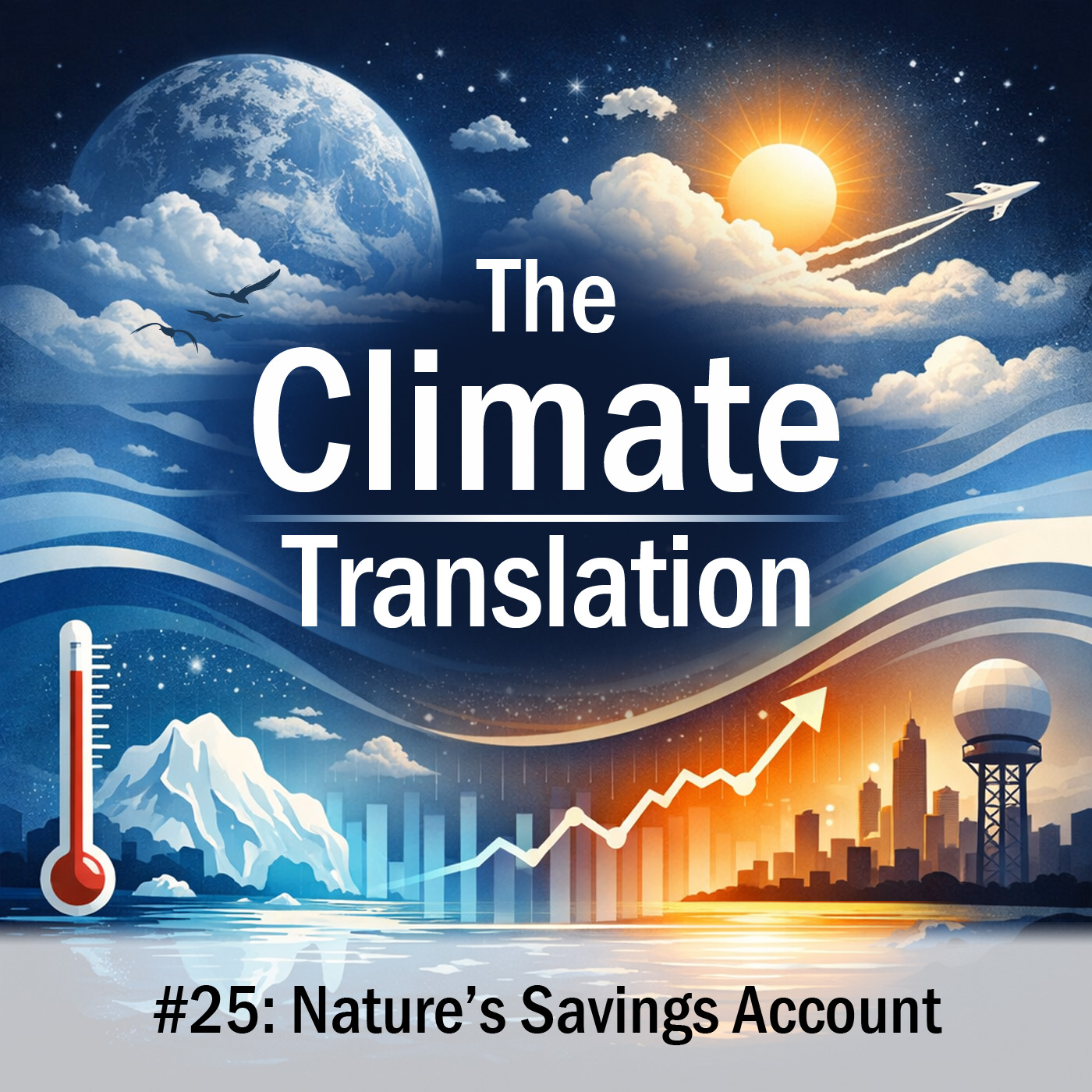
Nature's Savings Account
Earth may be the Blue Planet, but surprisingly little of its water is available for human use. This episode explores glaciers and mountain snowpack as natural freshwater savings accounts, the concept of Peak Water, and why timing matters as frozen reserves shrink.
Key topics
- Freshwater is one of the central ideas explored in this episode.
- Glaciers is one of the central ideas explored in this episode.
- Peak Water is one of the central ideas explored in this episode.
- Water security is one of the central ideas explored in this episode.
Full text
Episode transcript
This transcript is provided so listeners can explore the science discussed in the episode in full context.
Introduction
If you ask someone to describe Earth from space, they will probably say the same thing we all learned as kids: it is the Blue Planet. More than seventy percent of Earth's surface is covered by water. Oceans stretch from horizon to horizon, clouds move enormous amounts of moisture around the globe, and from a distance, water seems almost limitless. But appearances can be deceiving, because despite all that blue, the amount of freshwater available to support nearly eight billion people is surprisingly small.
If you gathered all of Earth's water into a single gallon jug, almost all of it would be saltwater. Of the small amount that remains as freshwater, most is not flowing through rivers or sitting in lakes; it is locked away, frozen in glaciers, stored in mountain snowpack, or buried deep underground. Many of the freshwater systems we depend on are natural savings accounts that collect water during colder, wetter periods and slowly release it when we need it most. Today, we are going to explore where Earth's freshwater actually comes from, why glaciers are far more important than most people realize, and what happens when some of our planet's largest natural water storage systems begin to change. Welcome back to the podcast. I'm Dr. Mac, and this is The Climate Translation.
The Freshwater Puzzle
When I teach introductory Earth science, I sometimes start with a simple question: How much of Earth's water do you think humans can actually use? The answers are usually all over the place, ranging from twenty percent to thirty percent, or sometimes even half. If you have ever looked at a globe, water seems abundant as oceans dominate the map, lakes and rivers crisscross continents, and clouds constantly move moisture around the atmosphere. But once we start doing the math, the picture changes quickly.
About ninety-seven percent of all water on Earth is saltwater contained in our oceans, leaving only about three percent as freshwater. Most of that freshwater is not easily accessible either: nearly seventy percent is locked away in glaciers and ice sheets, while another large portion exists as deep groundwater that is difficult to reach. That leaves only a tiny fraction in the places we normally think about, such as rivers, lakes, wetlands, and reservoirs. The water we rely on every day represents one of the smallest slices of the global water budget, serving as the checking account of a system where most reserves are stored elsewhere.
That is where glaciers become important. When people hear the word glacier, they often think of remote regions like Greenland, Antarctica, or high mountain peaks far from where people live. But glaciers are nature's savings accounts. Every winter, snow accumulates in high mountain regions, and if enough snow survives the summer melt season, it gradually compacts into ice. Over decades and centuries, glaciers store precipitation and act as delayed delivery systems that release water long after it fell from the sky. This delayed release is vital because rivers need water most during the dry season when rainfall is limited, temperatures are highest, crops are growing, and municipal demand peaks. For thousands of years, major river systems have depended on that natural storage cycle, which raises the question of what happens when that storage account starts shrinking.
Spending the Principal
It might be tempting to think that melting glaciers could solve water shortages, since retreating ice temporarily increases river flow. In the short term, that is often what happens, but the mechanism is counterintuitive. Imagine living off the interest generated by a retirement account. If you begin withdrawing the principal, you have more money available in the short term, but the account itself becomes smaller. Glaciers behave the same way: as they lose mass, streamflow increases and downstream communities see larger inflows during the warm season, creating the illusion of a healthy system during a period hydrologists call increasing runoff.
Eventually, the glacier shrinks to the point where there is less ice available to melt. The system reaches what hydrologists call Peak Water, which is the moment meltwater production hits its maximum. After that point, the trend reverses: the glacier continues melting, but annual runoff begins to decline because the remaining ice reserve is significantly smaller. Hydrologists are observing this pattern in mountain ranges worldwide, where some glacier-fed watersheds have already passed Peak Water and others are projected to reach it later this century.
While glaciers are not disappearing everywhere overnight and river systems rely on multiple inputs like rainfall, seasonal snowpack, and groundwater, shrinking glaciers reduce long-term reliability. Historically, glaciers served as a critical buffer by continuing to release water during drought years and smoothing out the natural variability of the hydrologic cycle. As these frozen reserves diminish, that buffering capacity weakens across nearly every continent, affecting hundreds of millions of people who depend on glacier-fed watersheds.
The World's Frozen Reservoirs
Glaciers do not exist in isolation; they sit at the headwaters of some of the most vital river systems on Earth. In South Asia, the Himalayas, often called the "Third Pole" due to their immense ice reserves, feed the Indus, Ganges, and Brahmaputra rivers, supporting hundreds of millions of people through agriculture, industry, sanitation, and drinking water. In Europe, Alpine glaciers feed major waterways like the Rhine, Rhone, and Po. In South America, communities along the Andes rely on seasonal meltwater during dry periods, and in North America, Rocky Mountain snowpack and glaciers sustain river systems across the western United States and Canada.
For generations, societies treated these frozen reservoirs as permanent, reliable fixtures of the landscape. However, glaciers respond directly to long-term temperature trends, expanding when snowfall exceeds melting and shrinking when melting outpaces accumulation. Global monitoring efforts show an unmistakable trend toward ice loss, with the past decade recording some of the highest mass losses in observational history. While this does not mean every glacier will vanish immediately, it indicates a sustained period where withdrawals have consistently exceeded deposits.
Glaciers integrate years of weather into a single climate signal, filtering out year-to-year noise to reveal long-term trends. The ongoing loss of glacial ice is especially critical because it coincides with growing populations, rising agricultural demands, expanding cities, and recurring droughts. The natural storage system is diminishing at the exact time human demand for freshwater continues to rise.
When the Timing Changes
Water challenges are not only about total volume; they are also about timing. Imagine receiving your annual salary in two lump sums in April and October rather than across twelve monthly paychecks. The total income is identical, but budgeting for monthly expenses becomes far more complicated. Freshwater systems function similarly: for centuries, seasonal snowpack and glaciers regulated delivery by storing winter precipitation and releasing it gradually during the spring and summer.
As mountain ice declines and snowpack becomes less reliable, more precipitation falls as rain rather than snow, causing runoff to occur earlier in the year and leaving less water available during peak summer demand. The Colorado River Basin illustrates this challenge clearly. Although often associated with arid landscapes, the river originates in the Rocky Mountains. Reservoirs like Lake Mead and Lake Powell were designed around gradual seasonal snowmelt, but warmer temperatures, reduced snowpack, and earlier runoff have made storage and delivery less predictable even as regional demand remains high.
Similar challenges are unfolding globally as communities in the Andes, the Himalayas, and the Alps adapt to shifting runoff timing. Rainfall, groundwater, and snowpack remain crucial components of the water budget, but the loss of glacial buffering means water managers must plan more carefully for seasonal variations. The fundamental challenge is ensuring that freshwater is available when and where communities need it.
Conclusion
Earth has abundant water, but accessible freshwater remains a finite, delicate resource distributed across rivers, lakes, groundwater, snowpack, and glaciers. For millennia, these systems operated within predictable seasonal rhythms, with mountain glaciers serving as nature's savings accounts.
As climate change alters temperature patterns, shrinking glaciers are shifting the timing, storage, and distribution of global freshwater resources. Adapting to these changes requires careful monitoring, thoughtful water management, and long-term planning tailored to a changing climate.
I'm Dr. Mac. This has been The Climate Translation. If you have a question about the climate that you have been too afraid to ask, or if you have a differing opinion, I want to hear from you. I can use your viewpoints in a future episode. You can reach me at TheClimateTranslation@gmail.com. I'll see you next time.