Episode 9 · March 5, 2026 · 19:21
The Global Pioneers
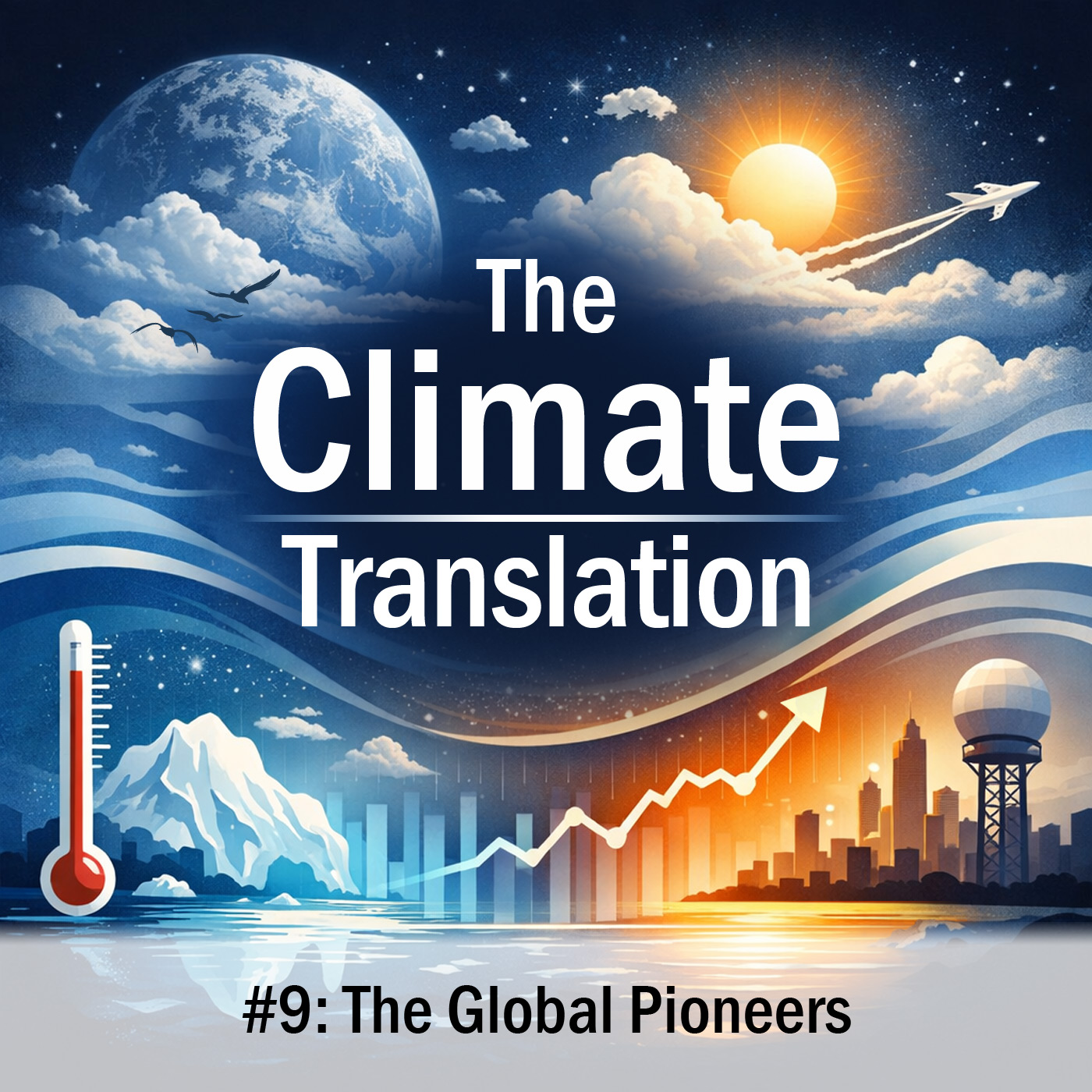
Costa Rica, Ethiopia, and Denmark provide three very different examples of climate action in practice—from paying for forest services and building resilience to transforming energy and agriculture. The common theme is experimentation rather than perfection.
Episode summary
The Global Pioneers
Costa Rica, Ethiopia, and Denmark provide three very different examples of climate action in practice—from paying for forest services and building resilience to transforming energy and agriculture. The common theme is experimentation rather than perfection.
Key topics
- Climate Solutions is one of the central ideas explored in this episode.
- Renewable Energy Transition is one of the central ideas explored in this episode.
- Reforestation is one of the central ideas explored in this episode.
Full text
Episode transcript
This transcript is provided so listeners can explore the science discussed in the episode in full context.
Introduction
In many parts of the world, the debate over whether human-induced climate change is real is already over. The conversation has moved on. The new question is: what do we do next? Today, we are visiting three countries that are showing what action can look like in the real world, not as theory, but as practice. We will look at how Costa Rica doubled its forest cover while growing its economy, how Ethiopia is building a green shield to protect its food supply, and how Denmark transformed itself from a fossil-fuel-dependent nation into a global wind-power leader.
These are not perfect stories, and they are not one-size-fits-all solutions. But they are proof of buy-in, resilience, and what becomes possible when the focus shifts from arguing about the problem to building the future. Welcome back to the podcast. I'm Dr. Mac, and this is The Climate Translation.
The Natural Capitalists
Our first stop is Costa Rica. If you have ever seen a travel brochure for this country, you have seen the image: lush rainforests, dense canopies, and wildlife everywhere. But that picture is relatively new. In the 1980s, Costa Rica had one of the highest deforestation rates in the world. Forest cover had dropped to just about 21 percent of the country's land area. Trees were being cleared rapidly for cattle, farming, and development. Economically, cutting forests made sense, while protecting them did not. That is the key point. Costa Rica did not reverse deforestation by asking people to be nicer to nature. They changed the math.
In the mid-1990s, the country launched something called a Payment for Environmental Services, or PES, program. The idea was simple but radical: forests provide real, measurable services, so landowners should be paid to maintain them. Those services include things we usually take for granted, such as clean drinking water, flood control, biodiversity, and carbon storage. Instead of treating forests as idle land waiting to be used, Costa Rica treated them like infrastructure.
Think of it this way: we pay people to maintain roads because roads benefit everyone. Costa Rica decided forests deserve the same logic. If your land helps keep rivers clean or stores carbon, the government pays you for that service. Suddenly, protecting trees was not just good for the environment, it made financial sense. The result was dramatic. Over the next few decades, forest cover rebounded to nearly 60 percent of the country. At the same time, Costa Rica's economy continued to grow. Ecotourism expanded, rural landowners had new income streams, and conservation stopped being charity work and became a business model.
Energy tells a similar story. For long stretches of the year, Costa Rica generates around 99 percent of its electricity from renewable sources, using a mix of hydropower, wind, and geothermal energy. This was not accidental. It was the result of long-term planning and consistent investment. But this is not a perfect success story, as Costa Rica's biggest challenge right now is funding. Much of the money that pays landowners to protect forests comes from a tax on gasoline. As Costa Ricans switch to electric vehicles, which is good for air quality and climate, that tax revenue is shrinking.
In other words, success is creating a new problem. The country is now racing to find new ways to pay for the services its forests provide without relying on fossil fuel use to fund conservation. That might mean new water fees, tourism-based funding, or international carbon markets. That brings us to the real lesson of Costa Rica: this is not about copying one policy or one tax, but about a mindset shift. Costa Rica treated nature as natural capital, something that creates value when it is maintained, not destroyed. That framing helped align environmental goals with economic ones. It shows what is possible when environmental protection is not treated as a sacrifice, but as an investment. It also shows that even successful systems have to keep adapting, because building a greener economy is not a one-time fix. It is an ongoing process. With that in mind, let's head to our next stop: an African country tackling climate resilience from a very different starting point.
The Green Shield
Unlike Costa Rica, Ethiopia is not trying to restore forests after industrial-scale deforestation. It is on the front lines of climate impact, facing some of the most severe droughts and floods in its modern history. Rainfall has become less predictable, growing seasons are shifting, and food security is under pressure. Ethiopia is experiencing what scientists sometimes call the biological blade, the sharp edge where climate change cuts directly into ecosystems, agriculture, and daily survival. Ethiopia's response is not primarily about carbon markets or long-term offsets. It is about resilience.
In 2019, the government launched the Green Legacy Initiative, one of the largest reforestation efforts ever attempted. Since then, more than 20 million citizens have taken part, planting an estimated 40 billion seedlings, with a target of 54 billion by 2026. Those numbers are enormous, but what matters more is how they are planting. Much of the effort focuses on fruit-bearing and native trees, including things like mangoes, avocados, and indigenous species that serve multiple purposes. These trees provide food, create income, stabilize soil, and reduce erosion. Their roots help hold land together during floods, and their shade helps reduce heat stress during droughts. In other words, the trees are doing double duty. They are helping absorb carbon, but they are also protecting livelihoods right now.
That approach has already begun to show results. Ethiopia has increased its national forest cover to over 23 percent, reversing decades of decline. In rural areas, communities are seeing improvements in soil stability and local microclimates. But this is where the story gets harder: planting a tree is easy, but keeping it alive is not. Many of these seedlings are being planted during record-breaking droughts. Water is scarce, heat stress is intense, and young trees are vulnerable. As a result, seedling mortality rates are high in some regions.
This is the central challenge Ethiopia faces. Reforestation is not just a climate project; it is a survival project. Survival depends on follow-through: watering, protection from grazing, long-term land management, and time. Ethiopia is now calling for increased international support, not just to plant trees, but to help these new forests reach maturity. A forest that dies after two years does not protect food supplies, stabilize land, or store carbon. That leads to the key lesson of Ethiopia's approach: climate solutions do not look the same everywhere. For countries like Ethiopia, climate action is less about optimization and more about defense. It is about building a green shield that protects people from heat, hunger, and instability, while also contributing to long-term climate goals. It reminds us that mitigation and adaptation often happen at the same time, and that success is not measured only in tons of carbon, but in resilience gained. With that in mind, let's move to our final example: a country that took a very different path, starting from a fossil-fuel-heavy economy and deliberately transforming it.
The Wind and the Cow
Denmark is often lauded as the gold standard for climate policy. The country's modern energy story began in the 1970s, after the global oil crisis exposed just how vulnerable fossil-fuel dependence could be. Instead of treating that crisis as a temporary shock, Denmark made a long-term decision to invest heavily in wind power and reduce its reliance on imported fossil fuels. That decision shaped decades of policy. Today, more than half of Denmark's electricity comes from wind alone, with offshore wind farms playing a central role. Danish companies helped pioneer turbine design, grid integration, and large-scale offshore construction. Wind did not just decarbonize their power system; it became a cornerstone of their economy.
Denmark's leaders are well aware that electricity is only part of the climate problem. The harder challenge lies in agriculture. Denmark is a major exporter of meat and dairy, and livestock farming produces large amounts of methane, a powerful greenhouse gas. Cutting methane is one of the fastest ways to slow near-term warming, but it is also politically sensitive because it directly affects farmers' livelihoods. This is where Denmark has taken one of its boldest steps yet. In 2024, the country announced a Green Tripartite Agreement, a deal negotiated between government, industry, and farming groups. Starting in 2030, Denmark will become the first country in the world to place a carbon tax on livestock emissions.
Under this system, farmers will pay a fee based on the methane emitted by cows and pigs, but this is not designed as a punishment. The revenue is earmarked to flow back into the system to fund green gas technologies, manure management, and reforestation efforts, while also helping farmers transition to lower-emission practices. The idea is simple but significant: if emissions have a cost, reducing them becomes part of the business model. Denmark is not pretending this will be easy. It is an experiment that treats agriculture as a climate sector, not an exception.
Even with this ambition, Denmark is running into a familiar obstacle: markets. In 2024, Denmark held an auction for six new offshore wind farms and received zero bids. Rising construction costs, inflation, and higher interest rates made the projects too risky for developers under the existing terms. This was a wake-up call. Even in a country with strong public support, mature technology, and decades of experience, the clean energy transition still has to make economic sense for the companies building it.
Denmark is now redesigning its auction system by adjusting subsidies, risk-sharing, and timelines to make sure wind power remains investable while staying aligned with climate goals. That is the real lesson of Denmark: leadership does not mean never hitting roadblocks, but being willing to adjust when conditions change. Denmark shows what climate action looks like at a mature stage, not just deploying clean technology, but continuously reworking policies so they survive real-world economics. They have proven that ambitious climate policy can coexist with prosperity, but also that it requires constant attention, compromise, and course correction.
The Blueprint
When we look at countries like Costa Rica, Ethiopia, and Denmark, there is a common reaction. People say, "Well, they're small," "Their total emissions don't compare to the United States or China," or "How much difference can they really make?" Mathematically, that is true, but that question misses the point. These countries are not important because of how much carbon they emit; they are important because of how they decide.
Think of climate action less like a single massive machine and more like a fleet. Large countries are the aircraft carriers: powerful, slow to turn, and expensive to redesign. Smaller countries are the pilot boats. They test routes, navigate shallow waters, and make mistakes early when mistakes are still survivable. What Costa Rica, Ethiopia, and Denmark are offering is not scale, but proof of concept.
Costa Rica shows what happens when you stop treating nature as scenery and start treating it as infrastructure. When forests are valued for what they do, protecting them stops being charity and starts being economics. Ethiopia shows what climate action looks like when the stakes are not abstract. When drought and food security are immediate threats, adaptation and mitigation collapse into the same project. Trees are not planted to hit a carbon target; they are planted to keep people fed. Denmark shows what long-term transition really looks like, not just deploying clean energy, but revisiting hard sectors like agriculture, adjusting policy when markets push back, and accepting that leadership means persistence rather than perfection.
These stories are different, but they share something important: in every case, progress required buy-in across the system. Government set the direction, industry was given incentives alongside constraints, and communities were brought into the process rather than treated as obstacles. None of this happened because people suddenly agreed on everything. It happened because climate goals were embedded into economic and social systems instead of sitting off to the side as ideals.
That is the blueprint: not a single policy or a universal solution, but a pattern. Climate progress happens when environmental goals are treated as design constraints, like safety or reliability, rather than optional add-ons. It also happens when countries are honest about tradeoffs. Costa Rica is now scrambling to fund the very forests it saved, Ethiopia is struggling to keep seedlings alive in a warming climate, and Denmark is learning that even mature clean energy systems have to adapt to market reality. These are not failures; they are what real-world problem solving looks like. The lesson is not that every country should copy Costa Rica, Ethiopia, or Denmark, but that waiting for a perfect, painless solution guarantees delay.
Small countries move first not because it is easy, but because someone has to. They map the terrain, find the pressure points, and show what breaks and what holds. Once those paths exist, larger countries lose one of their favorite excuses: "It can't be done." The climate challenge is not a lack of ideas; it is a lack of commitment to testing them, learning from them, and scaling what works. These countries do not solve climate change, but they do something just as important: they make the future less hypothetical. That is what a blueprint really is.
Conclusion
If there is one thing these stories make clear, it is that climate progress does not start with perfection; it starts with decisions. Costa Rica decided forests were worth paying for, Ethiopia decided resilience could not wait, and Denmark decided no sector was off-limits, not even livestock. None of these paths are simple, none are finished, and none scale automatically.
They show us something important: climate action becomes real when it is designed into how a society works, including how it grows food, produces energy, and measures value, rather than when it is treated as a side project. The future is not waiting for a single breakthrough or a single country to solve everything. It is being built, piece by piece, by places willing to test ideas, adjust when they fail, and keep moving anyway. That is the part worth paying attention to.
I'm Dr. Mac. This has been The Climate Translation. If you have a question about the climate that you have been too afraid to ask, or if you have a differing opinion, I want to hear from you. I can use your viewpoints in a future episode. You can reach me at TheClimateTranslation@gmail.com. I'll see you next time.